
Evaluate how broader economic trends, market conditions, interest rates, and the housing industry’s health affect contractors’ operations and strategic decision-making.
Edit
Home Improvement News
Quarterly Contractor Business Sentiment Trackers
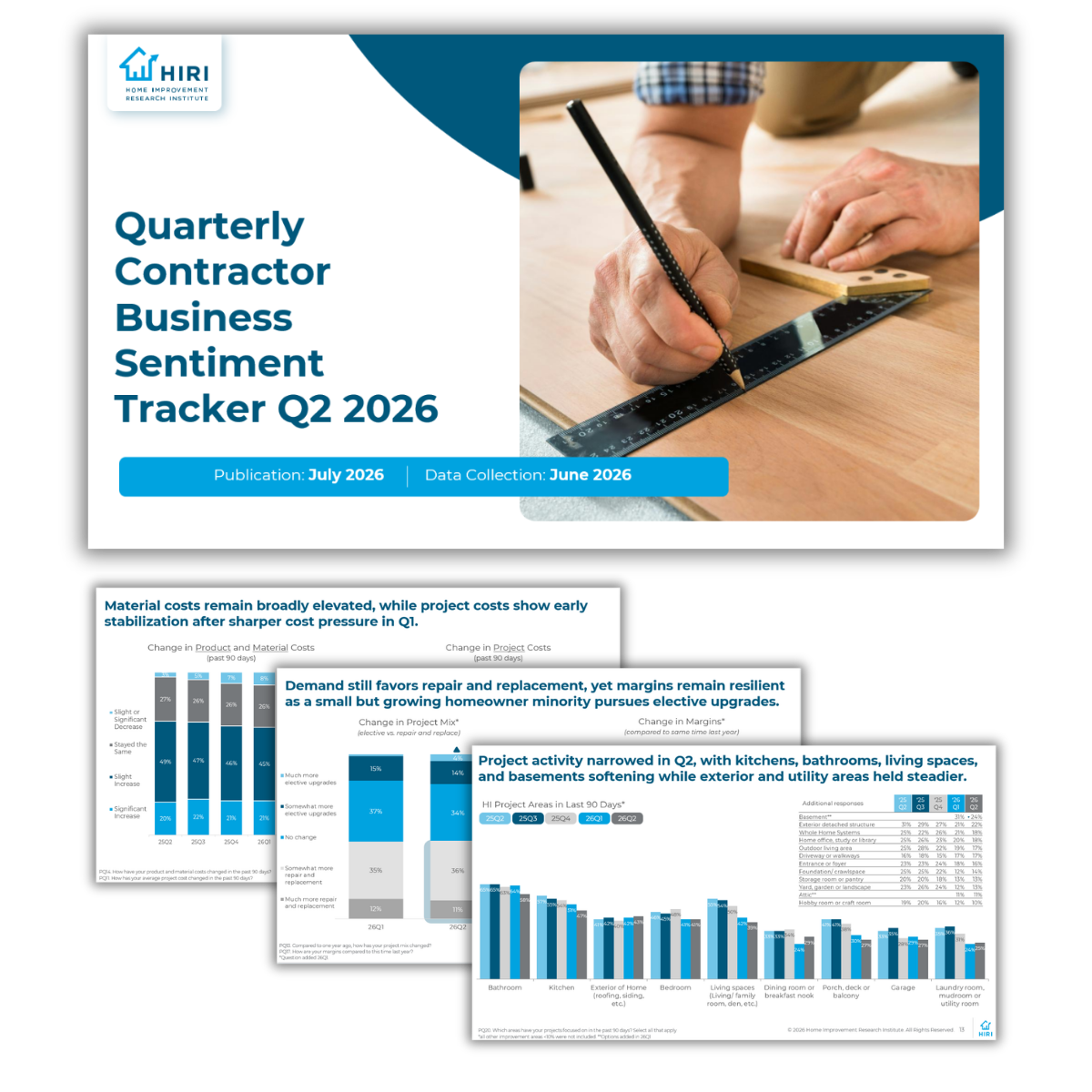
The construction industry is continually shaped by a variety of factors that influence contractors’ operations and strategic decision-making. The HIRI Quarterly Contractor Business Sentiment Tracker study seeks to evaluate the impact of broader economic trends, market conditions, interest rates, and the overall health of the housing industry on contractors’ businesses and more…
Objectives
Understand the types of projects contractors are engaged in along with the evolution of these engagements over time.
Explore labor shortages, material availability issues, and the adoption of new technologies, assessing their impact on efficiency, productivity, and project timelines.
Investigate the challenges faced during different project phases (bidding, execution, completion) and assess contractors’ satisfaction levels with key stakeholders (homeowners, manufacturers, suppliers.
Determine contractors’ current project backlog, anticipated future workload, and emerging project trends.
FAQs
What do contractors think about the current state of the home improvement industry?
Contractors remain broadly optimistic about the state of the home improvement industry, with energy efficiency and technology integration as leading growth opportunities, based on findings in the Home Improvement Research Institute's Quarterly Contractor Business Sentiment Tracker. More than half of contractors believe the market for home improvement will grow over the next year. Less than a quarter expect it to decline slightly or significantly. Contractors increasingly cite inflation and broader economic conditions as the primary macroeconomic pressures shaping their outlook over the next 12 months. At the same time, concern around tariffs has moderated, while newer factors such as labor availability, interest rates, and shifting consumer preferences are emerging as additional, though secondary, considerations.
How are home improvement contractors feeling about business this year?
Home improvement contractors are primarily feeling positive about business this year. Roughly two-thirds of contractors anticipate growth over the next 12 month, based on data from the Home Improvement Research Institute's Q1 2026 Quarterly Contractor Business Sentiment Tracker. Meanwhile, competitive intensity remains elevated, with half of contractors reporting more competition than a year ago. This suggests resilience, albeit in a more contested and cost-sensitive environment. Additionally, project pipelines show modest improvement, with bids and awards ticking up quarter-over-quarter and remaining above last year, supported by solid conversion. However, backlog is stable to slightly easing suggesting steady but not accelerating demand. For home improvement contractors, project activity currently remains concentrated in core renovation areas, kitchens, bathrooms, and primary living spaces, driving consistent demand for structural and finish materials.
What challenges are contractors facing in the home improvement market today?
Contractors are facing a variety of challenges, as well as opportunities, in the home improvement market. Material costs, inflation, and broader economic conditions remain the primary macroeconomic pressures shaping contractor outlooks, while concern around tariffs has eased, according to the Home Improvement Research Institute's Q1 2026 Quarterly Contractor Business Sentiment Tracker. On a business level, materials and labor remain the top challenges facing contractors, with a significant drop off in the first quarter of 2026. Of those with material challenges, costs dominate as a top concern, and contractors are primarily absorbing the increasing cost of products and materials for the time being. Additionally, code compliance remains the leading regulatory burden, with government regulations and inspections consistent sources of strain.
How has demand for home improvement changed in the past year according to contractors?
Demand for home improvement has remained relatively stable in the past year according to contractors. Project pipelines for contractors have shown modest improvement, with bids and awards ticking up quarter-over-quarter and remaining above last year, supported by solid conversion, based on the Home Improvement Research Institute's Q1 2026 Quarterly Contractor Business Sentiment Tracker. However, backlog ranges from stable to slightly easing, which suggests steady but not accelerating demand for home improvement in the past year. Project mix remains anchored in mid-sized jobs ($5k to $25k), but the notable uptick in smaller projects ($5k or less) points to some downtrading or smaller-scope activity. Against this, the sharp rise in project delays and cancellations (driven increasingly by budget constraints) is the clearest pressure signal, implying demand exists but affordability is tightening.
What is the outlook for home improvement businesses according to contractors?
Material costs and broader economic conditions continue to put pressure on the outlook for the home improvement market, yet sentiment among contractors is still positive, according to findings from the Home Improvement Research Institute's Q1 2026 Quarterly Contractor Business Sentiment Tracker. More than half of contractors expect market growth in the next 12 months, even as competitive intensity among home improvement businesses remains elevated. According to contractors, the biggest opportunities for growth in the market include energy efficiency improvements, technology integration, and expansion into new geographic markets. A majority of contractors anticipate that their business revenue will grow over the next year.
Are home improvement contractors struggling to find skilled labor?
Labor remains one of the top challenges facing home improvement contractors in 2026, but there has been a decline since the same period last year, according to the Home Improvement Research Institute's Q1 2026 Quarterly Contractor Business Sentiment Tracker. Of those who are experiencing labor challenges, availability is the main issue, with about half are struggling to find skilled labor and about half are struggling with the cost of labor. Additionally, about two-fifths of contractors with labor concerns report that they can't find the quality of labor that they desire. Retention and training are secondary labor challenges, based on research from HIRI.
What do contractors say about material costs in home improvement projects?
While material challenges have been declining in recent months, cost remains the core issue affecting about three-fourths of those with material challenges, based on data from the Home Improvement Research Institute's Q1 2026 Quarterly Contractor Business Sentiment Tracker. This trend signals a shift from supply chain disruption to price-driven strain. Despite most contractors reporting increased material prices, a notably smaller share is increasing their project costs. Many have to decrease project costs as their client’s budget constraints grow, and manly also indicated they are directly eating some of their margin as a result of increased material prices. The recent rise in home improvement project delays and cancellations, driven by budget constraints, also indicates that demand is present, but homeowners are increasingly price sensitive.
Edit
Related Reports
Not a Member Yet?
Explore free articles, infographics, and webinars to get even more value from HIRI
Infographic
Key Homeowner and Contractor Trends in Q1 2026
Home improvement activity has been off to a slower start in 2026, with...
Infographic
What’s Driving Home Improvement Spending in 2026?
Despite a continued level of financial strain and tempered customer co...
Webinar
HIRI Home Improvement Industry & Recent Research Update - November 2026
Join HIRI Executive Director Dave King for a timely update on the late...
Fast Fact
Homeowners who finance spend nearly 3 times more per project than those who don't, $12,500 versus $4,250, despite having lower net worth.
Financed and non-financed homeowners report the same median household ...

Enter a valid email address
There was an error
Thanks for subscribing!
© 2026 Home Improvement Research Institute. All rights reserved.